
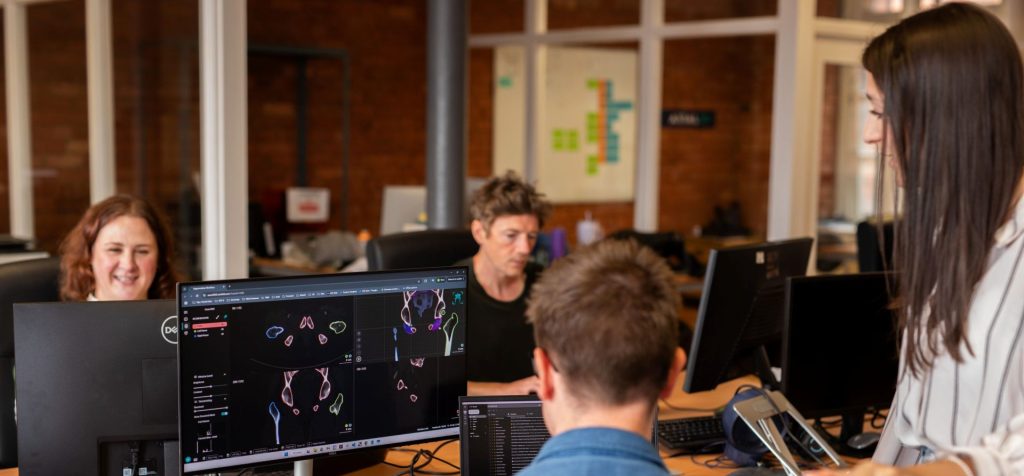
The medical device industry is entering an era of unprecedented clinical precision. Robotics platforms are advancing rapidly, structural heart interventions are expanding, and orthopedic workflows are becoming increasingly patient-specific. Across every specialty, the shift toward minimally invasive, personalized care is accelerating.
This progress is driving demand for a new type of infrastructure that can support personalization at scale. A digital foundation for personalized surgery is a connected, cloud-enabled infrastructure powered by patented AI algorithms that transforms medical imaging into structured, validated, and actionable anatomical intelligence. Rather than relying on isolated tools, it integrates AI-powered segmentation, landmarking, measurements, surgical planning, and device design into a single environment for patient-specific care.
Built on automation, this foundation standardizes how anatomical data is created, interpreted, and deployed across the enterprise. Instead of fragmented workflows, teams operate from a unified, planning-ready dataset that supports the full lifecycle of patient-specific care from surgical planning and predictive digital templating to cardiovascular device sizing, custom instrument design, robotic workflows, and clinical validation.
With this infrastructure in place, organizations move beyond manual execution bottlenecks. They can accelerate R&D, scale personalized offerings more efficiently, and extend custom solutions to broader patient populations while improving development speed, operational consistency, and ultimately, patient outcomes.
Scaling Patient-Specific Solutions
For many medical device organizations, the challenge with patient-specific care isn’t its clinical value; it’s the economic reality of scaling it. While demand continues to grow, most operational workflows were designed for isolated custom cases, not enterprise-level volume.
Today, patient-specific processes remain heavily dependent on manual segmentation, specialized expertise, and time-intensive preparation. As case volumes increase, resource requirements, turnaround times, and operational complexity grow alongside them. Manual processing also introduces variability, making it difficult to standardize outputs across teams, sites, or geographies.
A unified, AI-enabled digital foundation addresses these challenges by automating core processes such as segmentation, landmarking, and measurements. By generating consistent, planning-ready outputs from a single integrated data environment, organizations reduce reliance on manual effort and individual expertise.

This enables patient-specific workflows to evolve from case-based execution to enterprise-scale delivery, allowing organizations to expand personalized offerings without proportional increases in cost or complexity.
As a result, organizations can grow revenue through scalable patient-specific solutions and premium service offerings, improve margins through automation and reduced manual effort, increase market share through differentiated clinical capabilities, and create greater consistency through enterprise-wide digital integration.
Accelerating Innovation
As patient-specific care becomes routine, the competitive battleground for medical device companies is shifting from initial concept to time-to-market execution. Bringing differentiated, personalized solutions to surgeons faster is no longer just an operational advantage; it is becoming a key driver of clinical adoption and market leadership.
Despite growing demand, innovation is often slowed by fragmented data, manual 3D model preparation, and the need to recreate and validate anatomical datasets for each product iteration. These inefficiencies delay development, limit knowledge sharing across programs, and slow commercial rollouts.
A digital foundation changes this by transforming medical imaging into structured, reusable anatomical intelligence. With automated infrastructure in place, organizations can shorten development cycles for personalized solutions while accelerating innovation across their broader product portfolios.
Instead of becoming a temporary workflow output, patient-specific data becomes a strategic asset that informs product development, streamlines regulatory validation, and enables continuous, data-driven innovation throughout the device lifecycle.
Ultimately, accelerating innovation isn’t simply about moving faster; it’s about building a scalable foundation that delivers better, more precise solutions to more patients.
Axial3D: Powering Personalized Surgery at Scale
At Axial3D, we’ve built our platform around a fundamental principle: patient-specific care only scales when supported by the right digital foundation.
Our platform is built on a portfolio of global patents protecting the AI technology and automated workflows that power our machine learning models, all supported by a robust, clinically validated anatomical ground truth database.
Through this patented cloud-based infrastructure, we transform standard medical imaging into accurate, structured, and planning-ready 3D datasets that integrate directly into device development pipelines, pre-procedural planning, clinical workflows, and regulatory submission processes.
By delivering a fully validated, end-to-end platform, we enable medical device leaders to:
- Scale patient-specific solutions efficiently without proportional increases in labor or operational costs.
- Accelerate innovation across product portfolios using centralized anatomical intelligence.
- Improve clinical and operational outcomes for surgical teams and patients.
As the industry continues to evolve, the defining question will not be whether patient-specific care matters. It will be whether the infrastructure beneath it is capable of supporting it at scale.
The next decade of surgical advancement will be built on structured, connected, and scalable data. That is the digital foundation.
