
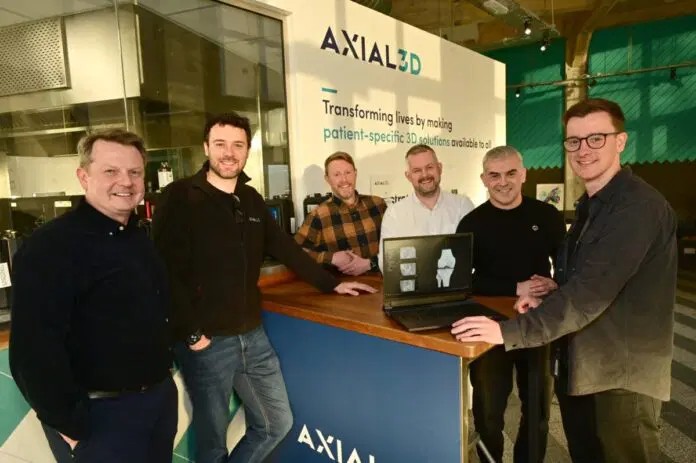
Bringing patient-specific surgical planning to scale requires more than incremental improvement. It demands new ways of working across industry, academia, and emerging talent.
The Knowledge Transfer Partnership (KTP) programme between Axial3D and Ulster University created exactly that kind of collaboration, bringing together expertise from multiple disciplines to tackle a shared challenge: how to make patient-specific surgical planning more scalable, efficient, and automated.
Today, creating patient-specific surgical plans is still largely a manual process, particularly when a surgeon user is required within the process, which brings a variety of opportunities for automation beyond Axial3D’s deep expertise in Ai driven workflow . Recognizing this, Axial3D used the KTP programme as a way to rethink these workflows and accelerate the development of new approaches.
Through the partnership, Axial3D worked closely with KTP associate Nathan Brennan and Ulster University to translate research and design expertise into practical, real-world innovation inside the business.
Bringing New Expertise into the Business
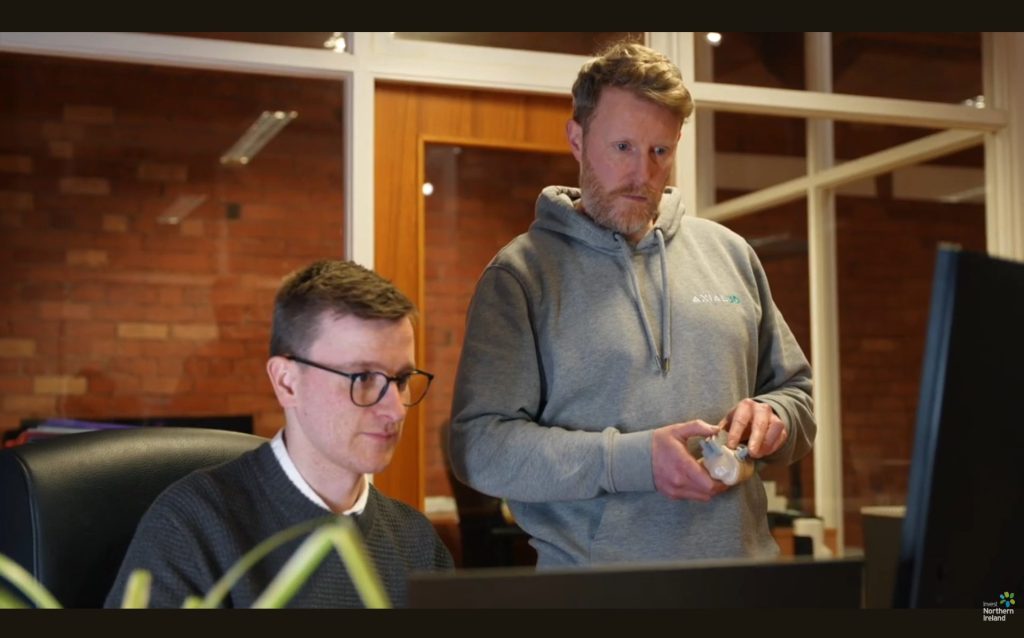
Nathan joined Axial3D through the KTP programme as a Product Designer, bringing expertise in user experience and interface design. His work focused on understanding how surgeons and medical engineers interact with existing workflows and identifying opportunities to improve them.

By combining design-led thinking with direct user research, Nathan helped uncover areas where automation could simplify complex processes and improve usability, bringing valuable new capabilities in-house for Axial3D.
A Partnership for Accelerating Innovation
For scaling technology companies, innovation often comes with uncertainty. The KTP programme helped Axial3D accelerate innovation by embedding new expertise directly into the business while connecting the team with academic insight from Ulster University.
The impact was significant.
The partnership accelerated product development timelines, strengthened internal capabilities, and helped bring new innovations to market faster. In some cases, solutions that may have taken three to five years to develop independently are already being sold today.
Creating Value for People and Business
The KTP programme didn’t just benefit Axial3D. It also created meaningful professional growth for Nathan, who gained experience in an entirely new field and secured a permanent role with the company following the project.
It’s a powerful example of how collaboration between industry, academia, and emerging talent can create value for everyone involved.
Looking Ahead
Innovation in healthcare requires more than technology; it requires the right partnerships. For Axial3D, the KTP programme has been transformative, helping accelerate our roadmap and strengthening our ability to deliver scalable, easy to use, patient-specific solutions to healthcare providers and medical device companies worldwide.
The success of this collaboration has reinforced the value of the KTP model, and we are already building on that momentum through a second KTP programme, continuing to bring together academic expertise and industry innovation to solve new challenges.
As we continue building the AI-powered digital foundation of personalized surgery, partnerships like this will remain essential to turning ambitious ideas into real-world impact.
