
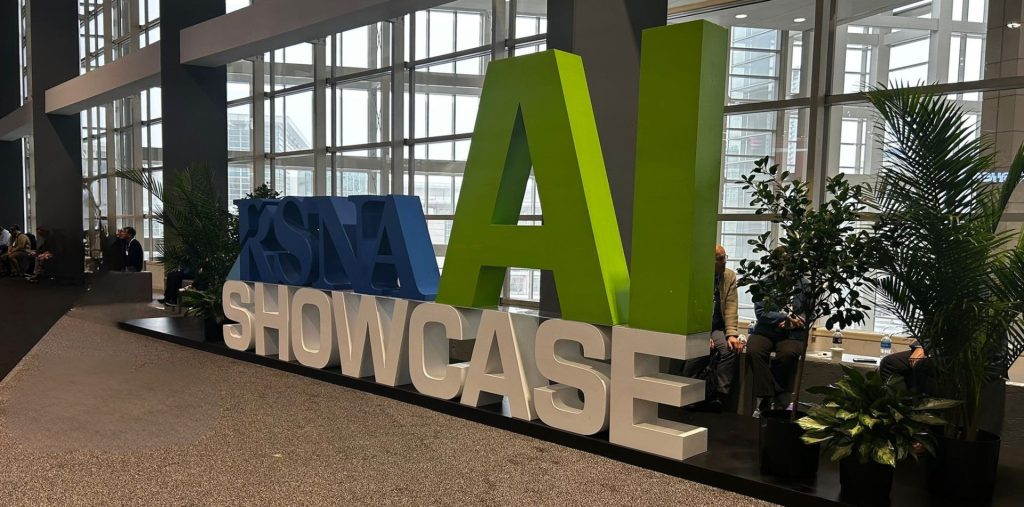

RSNA 2025 showcased the latest advances in medical imaging, AI-driven workflows, and patient-specific care. We spoke with our CTO, Rory Hanratty, to get his take on the key trends, innovations, and insights from the conference—and what they mean for the future of personalized healthcare.
1. What were the biggest trends at RSNA 2025?
Rory Hanratty: “AI has gone from the fringe to everywhere, it’s simply assumed now.”
Each year at RSNA, the conversation around AI grows, but this year marked a turning point. Four years ago, vendors were cautiously introducing AI; today, it’s integrated into nearly every booth, presentation, and workflow discussion. Its presence is taken for granted, a reflection of just how far the field has progressed.
Alongside AI, next-generation imaging hardware from companies like GE HealthCare, Siemens Healthineers, and Philips made a strong impression. The step-change in image clarity and spatial resolution opens the door to entirely new possibilities for radiology and beyond. High-impact areas like mammography, cardiac imaging, and pathology detection continue to gain momentum, but the real leap forward comes from hardware improvements, better resolution and clarity accelerating every aspect of imaging, from diagnosis to actionable insights.
2. How has the conversation around AI and imaging automation changed compared to previous years?
Rory Hanratty: “AI is viewed as assistive, not replacement, its role is to reduce burnout, accelerate tasks, and provide actionable insights.”
AI has moved from a “scary” or experimental concept to an expected part of the imaging workflow. Discussions at RSNA focused on how AI can support radiologists rather than add friction. The goal is to provide useful, actionable information, not just more data, to enable faster, more accurate diagnoses.
Radiologists are still asking the right questions,
- Where does this fit into my workflow?
- Does it actually help, or does it add another step?
- How does it impact my workload and accuracy?
AI isn’t a novelty anymore, it’s becoming a core part of how imaging evolves.
3. What challenges are imaging companies and radiologists still navigating with AI adoption?
Rory Hanratty: “Trust, transparency, and workflow integration are still key hurdles, but also opportunities.”
Two main challenges we hear often,
- Trust and transparency: Radiologists want to understand how algorithms reach conclusions before relying on them.
- Workflow integration: AI tools must fit seamlessly into existing workflows, extra logins or new interfaces create friction.
Beyond workflow, data is both a challenge and an opportunity,
- Training AI: Large volumes of high-quality imaging are essential for building reliable models, still difficult to obtain at scale.
- Operational access: Once scans are acquired, companies like Axial3D are finding innovative ways to integrate imaging into clinical workflows, making patient-specific solutions faster and more scalable.
Solving these challenges unlocks reliable, impactful, and widely accessible medical imaging solutions.
4. What were the biggest opportunities you saw at RSNA, where does the future of imaging seem to be heading?
Rory Hanratty: “Imaging should play a role throughout the entire care pathway, not just at diagnosis.”
Today, imaging is often a single point-in-time event, it informs a diagnosis, and then much of that value is lost as the patient moves downstream. The future is different,
- Guiding clinicians in patient conversations
- Helping surgeons visualize complexity
- Enabling longitudinal comparisons, how does a pathology progress over time?
- Supporting both surgical and non-surgical decisions
- Improving patient understanding of their condition
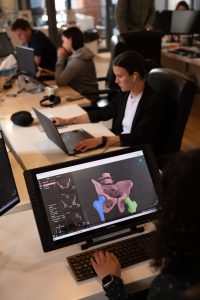
Next-generation imaging hardware also opens entirely new possibilities. The clarity and detail coming from modern CT and MR systems enable the kind of 3D insights and data Axial3D specializes in. Imaging data no longer disappears after diagnosis, it becomes a continuous, structured part of the patient’s care.
5. Imaging in the Care Pathway: Today vs. the Future
Rory Hanratty: Today, a patient presents with a symptom (e.g., back pain), is referred for imaging, a radiologist interprets it, and results are sent back to the referring clinician. Imaging is often used only once, and earlier data rarely informs follow-up care.
Future (Potential): Imaging becomes a living dataset that follows the patient through every stage of care,
- 3D models and actionable information generated from the initial scan
- Surgeons reviewing the same data during planning
- Follow-up scans compared automatically in 3D
- Patients visually understanding their condition
- Clinicians monitoring progression with precise measurements
A single dataset informs diagnosis, planning, treatment, and recovery, unlocking better outcomes for patients and clinicians alike.
RSNA offers a firsthand look at the future of medical imaging, and this year was no exception. Rory’s insights highlight how AI, advanced imaging, and patient-specific workflows are transforming care and improving outcomes. At Axial3D, we’re using these learnings to drive solutions that make personalized care practical, scalable, and accessible for hospitals and medtech partners alike.

