

The medical device industry is constantly evolving to deliver better outcomes for patients. A key challenge for companies today is how to develop patient-specific solutions, quickly and at scale. Automated, AI-driven, cloud-based platforms are emerging as a critical enabler, helping bring devices to market faster and more efficiently.
Traditionally, creating patient-specific medical devices has been a time-consuming and resource-intensive process. These workflows rely on desktop-based workstations and highly trained engineering or clinical experts to manually segment medical images, identify anatomical landmarks, and perform critical measurements for surgical planning. This approach is constrained by local computing power, requires significant hands-on time, and can take hours or longer depending on data volume and internal backlogs.
Because these workflows are tied to individual machines and users, they are difficult to scale across teams or locations. Manual processes for segmentation, landmarking, and measurements are also inherently subjective, leading to variability, errors, and inconsistencies that can impact downstream surgical planning and device design.
In contrast, cloud-based platforms enable automated, AI-driven segmentation alongside standardized landmarking and measurement tools. This allows teams to generate consistent, high-quality 3D data that supports faster, more accurate surgical planning. With scalable computing power and centralized access, cloud platforms remove bottlenecks, improve collaboration, and streamline workflows across organizations.
Cloud-based segmentation provides a clear path forward for medical device companies. By combining cloud infrastructure with advanced AI, organizations can automate complex workflows, reduce time to market, and deliver patient-specific solutions at scale, ultimately improving both operational efficiency and surgical outcomes.
What is the cloud?
The cloud is a network of remote servers that store, process, and manage data online, enabling secure access, scalability, and flexible computing without relying on local hardware.
Alternative: Non-cloud (on-premises) systems require local servers and IT infrastructure, which can be costly, less flexible, and harder to scale
Top 3 Benefits of a Cloud-Based Platform
Scale dynamically and efficiently
Cloud-based platforms offer the ability to easily scale capacity up or down based on demand, enabling companies to dynamically respond to fluctuations in their patient specific needs without significant upfront and fixed investment in infrastructure. More traditional types of segmentation software and surgical planning tools would require additional licenses, high specification workstations and additional staff members to be in place well in advance, to be able to handle growing volumes of data.
How does the cloud handle secure DICOM handling through AWS?
AWS secures DICOM medical images with encryption, access controls, and audit logs, protecting patient data while supporting efficient sharing and integration with healthcare workflows.
Alternative: Local storage may require manual security setup and ongoing IT maintenance, increasing risk of errors or data breaches.
Consistent and Accurate Segmentation
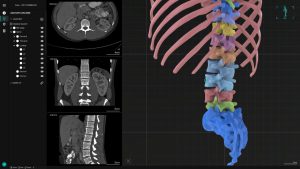
By utilizing machine learning algorithms, cloud-based platforms can automatically segment data based on predefined criteria or patterns. Unlike manual segmentation, which can be subjective and prone to human error, automated segmentation algorithms can process large datasets quickly and consistently, leading to more accurate results.
What makes cloud-powered segmentation faster and more consistent?
Cloud-powered segmentation uses AI to automatically process large datasets, reducing human error and delivering faster, more consistent, and accurate results than manual methods.
Alternative: Manual, non-cloud segmentation relies on human effort, which can be slow, subjective, and prone to mistakes, especially with large or complex datasets.
Global Accessibility
Cloud-based segmentation platforms allow users to access and upload data from anywhere with an internet connection. No fixed licenses or high specification workstations are required for the user to complete a segmentation. This means that team members can work remotely, collaborate across different locations, or access the segmentation tools while traveling. This flexibility is particularly beneficial for companies with distributed teams or global operations, as it ensures that all users can easily upload data regardless of their location. Data residency requirements can also be maintained by selecting the appropriate region(s) in the cloud providers global infrastructure to host the platform.
How does the cloud support data residency through AWS?
AWS lets organizations store data in specific regions, ensuring compliance with geographic or regulatory requirements while benefiting from cloud scalability.
Alternative: Non-cloud setups require manual control of physical storage locations, which can be complex and limit collaboration.

See what this looks like in practice.
Read next: How Axial3D Leverages AWS Cloud to Scale Personalized Surgery and discover how cloud + AI are enabling scale.
